What You Should Know About Crypto
From the outside looking in, crypto seems very complicated. On one side, you have experts talking about leverage and exchanges, and on the other, you have people outlining all the crypto scams that exist in the market. It’s no wonder that many people face analysis paralysis, fear, and other states of mind that deter them from considering investments in this field. But what if we told you that crypto is actually quite easy to understand if you break it down to its basics? Here is what you need to know.
The Types of Crypto Assets
The first thing you need to know is that crypto goes beyond cryptocurrencies and instead includes several other assets. So, which are they?
Payment Coins

These are the original cryptocurrencies, which were designed to help people make and receive payments without relying on banks and other financial institutions. Here, you have coins such as Bitcoin, Litecoin, and other household names in the cryptocurrency market. They work quite simply. Both the recipient and the sender set up wallets in which they can hold the crypto, and when they want to initiate a transfer, the money flows directly from the sender to the recipient, as there is no intermediary necessary for this process. Instead, the decentralized network governs the transaction through the applicable consensus mechanisms set out by users in the network, such as PoW and PoS.
These coins are highly regarded for their lack of censorship, as there is no centralized authority in charge of the transactions. Additionally, these transactions are fast, globally accessible, and cheaper than traditional payment methods. But on the downside, the prices of these coins tend to fluctuate a lot, such that using them for daily purchases is not ideal. A coffee that was $1 today can easily be $2 tomorrow due to these price swings. On top of this, the networks on which these coins operate can only handle a limited number of transactions every second, and transactions can cost more and take more time when their demand is high. And that’s not to mention that consensus mechanisms such as PoW use a lot of energy, which has been raising environmental concerns.
Stablecoins

Due to the issues faced with payment coins, stablecoins have become the preferred alternative for short-term transactions. Unlike payment coins whose value depends on the value of the said coins in the market at the time of the transaction, stablecoins have their values tied to major currencies. For example, the USDT is tied to the US dollar. As such, these coins are much less volatile as they do not experience the same price swings as the traditional payment coins.
In addition to all the benefits that come from using cryptocurrencies, stablecoins come with the added advantage of serving as a reliable alternative for savings and investments. And that is because they can buffer their holders against unstable currencies, inflation, and other economic factors. What’s more, they are practical for daily use as they are fast and cheap to transfer and have relatively stable prices.
However, since they are tied to major currencies, their stability comes down to the issuers who are maintaining the reserves. In cases of mismanagement, these coins can collapse. As such, users must verify that the issuers are playing by the rules and not making decisions that would impact their coins negatively.
Utility Tokens

Have you heard of tokens such as ETH and BNB? These are crypto assets that users can rely on to gain services within the larger blockchain ecosystem. Take ETH, for example. It is tied to Ethereum, which is a payment coin, and it helps users pay for ‘gas fees’ when they are running smart contracts. Other coins have their own versions of these tokens. The whole idea behind them is to incentivize users in the network to participate, as they then get rewarded with these tokens, which serve as a form of payment within the system. They also encourage innovative practices, such as lending and the creation of NFT (non-fungible token) marketplaces. But since their value relies on the success of the network, they are not the most stable of assets in terms of value. Using Ethereum as our example again, if its demand were to fall, then the value of ETH would fall as its utility would take a hit. Also, there is the issue of regulations. Given how these tokens work, some of them are seen as securities, which restricts their use.
Security Tokens

Crypto assets become even more exciting when you turn your attention to their role in the modernization of capital markets. In this digital age, people are now able to represent traditional assets such as bonds and stocks in the form of crypto, thus allowing their owners to sell them on the open market. Understandably, this innovative approach has paid off quite well. To start with, people are now able to purchase partial ownership of larger assets, such as shares in buildings or even partial ownership of homes. In other cases, complete transfers of the properties take place. Secondly, the use of crypto has allowed these financial transactions to take place faster than they would in the traditional market. And best of all, the use of Blockchain has ensured that all parties to the transactions are able to maintain and access transparent records on these assets.
But while these tokens have tons of benefits, they are subject to a wide range of complex regulations that have slowed down their adoption. What’s more, since these assets are generally more expensive than payment coins and stablecoins, there is less liquidity in the market. It takes more time to buy and sell such assets. Luckily, there has been more investment in legal frameworks to catch up with the current crypto trends in a bid to encourage more adoption of these tokens and open up this potentially huge global market.
Non-Fungible Tokens
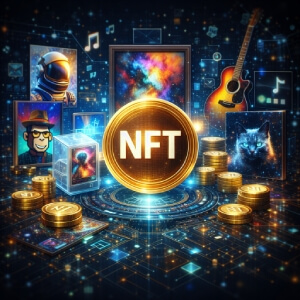
We talked about the role of utility tokens in the establishment of NFT marketplaces. But what exactly are NFTs? Well, these are tokens that represent the ownership of physical as well as digital assets. These vary a lot and include items such as:
- Art.
- Collectibles.
- Music.
- In-game items, etc.
Each item that is up for sale gets a unique token, which transfers to the new owner upon sale. So, why would people opt for this form of ownership? For one, the use of NFTs allows creators to prove that their work is authentic and opens them up to a global market where they can sell their original works. Many creators have gone digital and made a tidy profit this way. Secondly, creators are able to program royalties into their sales contracts such that for every subsequent sale, they get to earn money. With all these perks, what could go wrong? Unfortunately, many NFT sales rely on speculation, such that prices are not always indicative of value and can easily be the result of market hype. To add to this, there have been several cases of scams and counterfeits in the market, which have dampened people’s trust in these tokens.
Governance Tokens

Organizations that use Blockchain technology use governance tokens to issue voting rights among their communities. This way, they allow their communities to be part of the key decisions, such as upgrades, fees, and spending, which is similar to the consensus mechanisms you would see in a public network. As such, this inspires transparency within the organizations and encourages more buy-in from the community, including in the implementation of the decisions. It is important to note, though, that where voting power resides with the people with the largest shares, then voting processes are not always deemed fair. In some of these cases, some members of the community may not participate in the voting or may be apathetic to the decisions arrived at after the final count.
Capitalizing on Crypto Assets
It is evident that crypto assets introduce global accessibility to investment and savings opportunities, increase transparency in transactions and operations, foster innovation, and are financially inclusive. However, they are also subject to risks such as volatility, scams, speculation, and regulatory uncertainty. Therefore, anyone who wants to get in on their benefits has to be strategic in order to address these risks and avoid the common pitfalls that investors face in this industry. Luckily, you can maneuver these waters and succeed by doing the following:
- Learn more about crypto. Go to the basics and uncover how Blockchain technology works, how wallets come into play, the ins and outs of the various crypto assets, and more. You can easily get this information from sites like ours and can go ahead and dive into the scientific side by poring through open-access academic articles. Having knowledge is key, as it enables you to sort the truth from the hype or alarmist messaging that you may come across once you start making investments.
- Start with small amounts. A common mistake that people make when starting crypto investing is going big as they seek high profit margins. But as much as this carries the possibility of turning a tidy profit, it also exposes you to more risk at a time when you are still figuring out how the market works. Instead of going all in, start with small amounts, as this allows you to gauge how well you understand these assets while also giving you a buffer against volatility.
- Diversify your investments. While crypto is one of the most sought-after investments in this age, it should be one part of your portfolio. Just like you would with traditional assets, you need to diversify so as to avoid having your eggs in one basket. Not only can you diversify in terms of crypto assets, but you can also do this by integrating traditional investment vehicles such as emergency funds and savings accounts.
- Practice security habits. Crypto transactions are often highly secure. However, security risks still exist, more so when it comes to user access. Hackers can try to access your crypto by logging into your wallet. You can play it safe by enabling multi-factor authentication, storing your long-term assets in hardware wallets, and using highly secure passwords.
It also helps to be part of crypto forums where you can learn from others, keep an eye on scams, and get crypto updates as they happen.
𝗕𝗹𝗼𝗰𝗸𝗰𝗵𝗮𝗶𝗻 𝗙𝘂𝗻𝗱𝗮𝗺𝗲𝗻𝘁𝗮𝗹𝘀 — 𝗛𝗼𝘄 𝗕𝗹𝗼𝗰𝗸𝘀 𝗮𝗻𝗱 𝗖𝗵𝗮𝗶𝗻𝘀 𝗪𝗼𝗿𝗸 𝗦𝗲𝗰𝘂𝗿𝗲𝗹𝘆
— Web3Cryptic (@therealonazi) January 24, 2026
Imagine a 𝗻𝗼𝘁𝗲𝗯𝗼𝗼𝗸 where each 𝗽𝗮𝗴𝗲 is a 𝗯𝗹𝗼𝗰𝗸. Once you write on a 𝗽𝗮𝗴𝗲, it’s sealed with a special code called a 𝗵𝗮𝘀𝗵. Every new 𝗽𝗮𝗴𝗲… pic.twitter.com/WuEqqDJkCc
Token vs Coin — Structure, Power & Risk
— Akshay | $P2P (@AkshayLadumor) January 25, 2026
1️⃣ Meaning
In crypto, the difference between a coin and a token is about who controls the blockchain.
• Coins power a blockchain
• Tokens use a blockchain
This one line explains everything.
2️⃣ Coins = Infrastructure Layer
Coins exist… pic.twitter.com/sdUoB661I1